
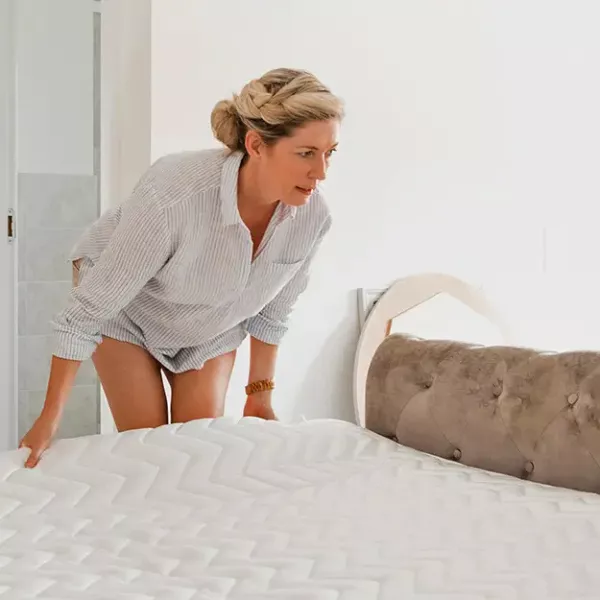
Why rotate your mattress?
The same areas of a mattress can experience repeated pressure every night, particularly around the shoulders, hips and other high-load areas. Regularly rotating a suitable mattress changes where those pressure points sit.
This can help distribute wear more evenly and reduce the likelihood of one area becoming noticeably more compressed than another. However, rotation is not suitable for every mattress, so always check the manufacturer's care instructions first.
Quick guide to rotating a mattress
Check first
Look at the manufacturer's instructions to confirm whether your mattress should be rotated.
Rotate end to end
For a two-way mattress, turn it 180 degrees so the head end becomes the foot end.
Don't flip automatically
Rotating is different from turning the mattress over. Many modern mattresses are designed for one-sided use.
Use two people
Mattresses can be heavy and awkward. Getting help makes rotation easier and reduces the risk of injury or damage.
What does rotating a mattress mean?
Rotating a mattress means turning it around so that the end previously at the head of the bed moves to the foot of the bed.
180° MATTRESS ROTATION
HEAD → MATTRESS → FOOT
FOOT → MATTRESS → HEAD
You are changing the orientation of the mattress on the bed base without turning the sleeping surface upside down.
How to rotate a mattress step by step
1. Check the instructions
Confirm that your particular mattress is designed to be rotated and check the recommended frequency.
2. Clear the bed
Remove bedding, pillows and anything else that could get in the way.
3. Check the space
Make sure there is enough room around the bed to move the mattress without catching walls, furniture or other objects.
4. Lift the mattress
With another person if necessary, lift and move the mattress rather than dragging it across the floor.
5. Turn it 180°
Move the head end to the foot end while keeping the mattress the correct way up.
6. Reposition it
Centre the mattress on the base and check that it is sitting correctly before replacing the bedding.
Rotating vs flipping a mattress
These two terms are often confused, but they describe different actions.
Rotating
Turn the mattress end to end, usually through 180 degrees.
Example: the head end becomes the foot end.
Flipping
Turn the mattress over so the opposite surface becomes the sleeping surface.
Important: only flip a mattress if the manufacturer specifically says it is designed for two-sided use.
Can you rotate every type of mattress?
Not necessarily. The correct care routine depends on the construction of the mattress and the manufacturer's instructions.
| Mattress type | Rotate? | Flip? | What to check |
|---|---|---|---|
| Memory foam | Often suitable | Usually no | Follow the specific care instructions for the model. |
| Pocket sprung | Often suitable | Depends | Check whether it is one-sided or double-sided. |
| Hybrid | Often suitable | Usually no | The comfort layers may be designed for one sleeping surface. |
| Latex | Often suitable | Depends | Latex mattresses can be heavy, so take care when moving them. |
| Orthopaedic / specialist | Check instructions | Check instructions | Construction and intended support can vary significantly between models. |
How often should you rotate a mattress?
There is no single schedule that applies to every mattress. The manufacturer's care instructions should take priority.
If the manufacturer recommends regular rotation, follow that schedule rather than waiting until you can see a visible dip or feel uneven wear. Consistent rotation is intended to distribute normal use rather than correct severe mattress deterioration.
Should you rotate a new mattress?
A new mattress may benefit from being rotated if the manufacturer recommends it. The important point is to start with the care routine specified for that particular model.
Do not assume that a mattress needs to be flipped simply because an older mattress used to be turned over. Modern mattresses are often constructed with a dedicated sleeping surface and support layers arranged in a specific order.
Signs your mattress may need attention
Uneven wear
One area may feel softer or more compressed than the rest of the mattress.
Visible impressions
Persistent body impressions can indicate normal wear or that the mattress is reaching the end of its useful life.
Loss of comfort
If the mattress no longer feels supportive or comfortable, rotation may not be enough to solve the problem.
Age-related wear
A mattress that has become significantly worn may need replacing rather than simply rotating.
Mattress rotation safety tips
- Get help with large or heavy mattresses.
- Use the mattress handles if the manufacturer provides them and says they are suitable for moving.
- Do not lift a mattress by delicate fabric, piping or loose covers.
- Make sure there is enough space around the bed before moving it.
- Keep children and pets away while moving a heavy mattress.
- Check that the mattress is correctly positioned on the base before using the bed again.
Mattress rotation checklist
Confirm that rotation is recommended for your mattress.
Clear the mattress before moving it.
Make sure furniture and other obstacles will not interfere.
Use two people where the mattress is large, heavy or awkward to handle.
Move the head end to the foot end while keeping the correct surface facing upwards.
Centre the mattress on the bed base before replacing your bedding.
Frequently Asked Questions
Which way do you rotate a mattress?
For a mattress designed to be rotated, turn it 180 degrees so the head end becomes the foot end. Keep the sleeping surface facing upwards unless the manufacturer specifically says the mattress can be flipped.
Do you rotate a mattress or flip it?
Rotation means turning the mattress end to end. Flipping means turning it over. They are different actions, and you should only flip a mattress if its manufacturer says it is designed for two-sided use.
Can you rotate a memory foam mattress?
Many memory foam mattresses can be rotated, but the correct care routine varies by model. Check the manufacturer's instructions before doing so.
Can you rotate a pocket sprung mattress?
Many pocket sprung mattresses can be rotated from head to foot. Whether they can also be flipped depends on whether the mattress is designed for one-sided or two-sided use.
How often should I rotate my mattress?
Follow the manufacturer's recommended schedule. Different mattress constructions have different care requirements, so there is no universal rotation frequency.
Can rotating a mattress fix a dip?
Rotation may help distribute normal wear more evenly, but it will not necessarily fix a significant or permanent sag. If your mattress has developed substantial deterioration, check the manufacturer's warranty or guarantee terms and consider whether replacement is appropriate.
More Bed & Mattress Guides
Look after your mattress for longer
Check the manufacturer's instructions, rotate your mattress correctly when recommended and make mattress care part of your regular routine.
Explore Mattress Guides